combining dfas and operators
in the previous lecture we learned how to design dfas given a language. how can we design a dfa that accepts many languages?
combining dfas
to design a dfa that accept many languages, we first separate the larger language into smaller languages, and then combine them. let’s see an example.
example 1
problem: design a dfa $M$ such that its language is the set of strings that contains 11 as a substring or ends with 0.
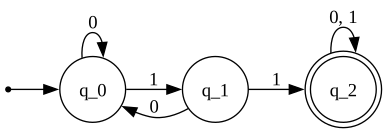
solution: we can split this larger language into two smaller languages (sets). the first set is the set of strings that contain 11. we can design the first dfa $A$ like the following:
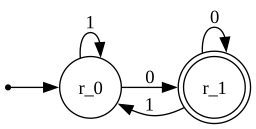
then, we design the dfa $B$ for the second language, where it is the set of strings that end with 0.
to combine these small dfas together, we first enumerate all possible states for $A$ and $B$ in tuples (the order does not matter):
- $(q_0, r_0)$
- $(q_1, r_0)$
- $(q_2, r_0)$
- $(q_0, r_1)$
- $(q_1, r_1)$
- $(q_2, r_1)$
this is the set of all possible states ($Q$) of $M$. you might have notices it is a cartesian product of the states for the dfas $A$ and $B$; where $Q_M = Q_A \times Q_B$.
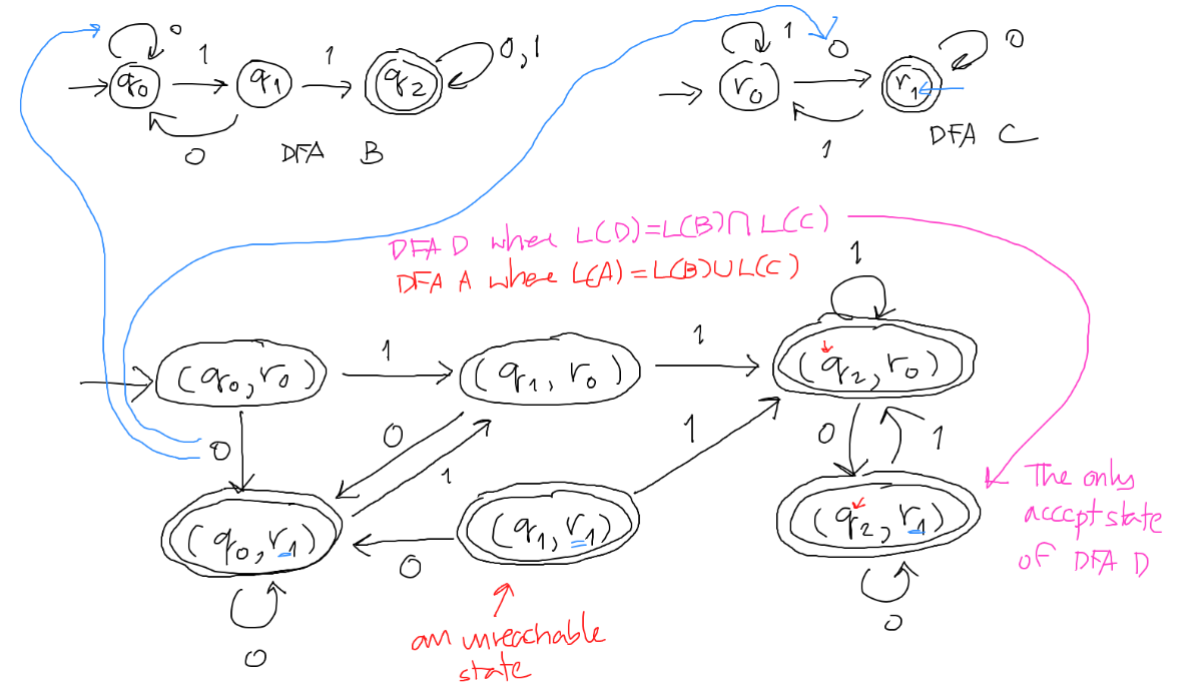
then we redraw the transition functions by executing both dfas at the same time. for each input, we draw the transition function pointing to the state of both machines at the same time.
combining dfas, formally
given a dfa $B = (Q_B, \Sigma, \delta_B, q_B, F_B)$, and another dfa $C = (Q_C, \Sigma, \delta_C, q_C, F_C)$;
to construct a dfa $A = (Q_A, \Sigma, \delta_A, q_A, F_A)$ where $L(A) = L(B) \cup L(C)$, we write that:
\[Q_A = Q_B \times Q_C = \{(q, r) \mid q \in Q_B \land r \in Q_C\}\]where its transition functions are:
\[\delta_A((q, r), a) = (\delta_B(q, a), \delta_C(r, a))\]and its states:
\[q_A = (q_B, q_C)\]finally, accept states:
\[F_A = \{(q, r) \mid q \in F_B \lor F_C\}\]regular languages
a language $B$ is regular if there exists a dfa $A$ that recognizes it ($L(A) = B$).
if we can prove that a language is regular, we must be able to construct a finite state machine to recognize it.
if we can prove that a language is not regular, we cannot construct a finite state machine to recognize it.
given regular languages $A$ and $B$ (recognized by dfas $M_A$ and $M_B$), $A \cup B$ is a regular language.
regular (language) operators
operators are similar both in arithmetic and in theory of computation.
in arithmetic, objects are numbers, and tools are operations for manipulating numbers.
in theorey of computation, objects are languages (sets of strings), and tools are operations for manipulating languages.
assume the languages $A$ and $B$; we define the regular operations are following:
- union: $A \cup B = {w \mid w \in A \lor w \in B }$
- same as in set theory
- concatenation:
$A \cdot B = AB = {xy \mid x \in A \land y \in B}$
- let $A = {00, 11}$ and $B = {010, 101}$
- $A \cdot B = {00010, 00101, 11010, 11101}$
- kleene star:
$A^* = {x_1x_2…x_k \mid k \geq 0 \land x_i \in A }$
- ${\epsilon} \cup A \cup AA \cup AAA \cup AAAA \cup …$ ($\epsilon$ is the empty string)
- example: let $A = {00, 11}$; $A^* = {\epsilon, 00, 11, 0000, 0011, 1100, 1111, 000000, …}$
- when $A = \emptyset$, $A^* = {\epsilon}$.
theorem: if $A$ and $B$ are regular languages, $A \cup B$ is a regular language.