deterministic finite automaton (dfa)
a dfa takes an input, and gives an output in the form of either accept or reject.
state machines
we usually use state diagrams to model how different automatons interact
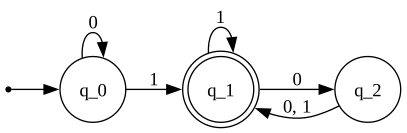
with each other. consider this following state diagram, representing the
finite state machine $M_1$. $M_1$ takes a string input consisting of
0s and 1s.
info: in the notes, i sometimes use the words dfa and state machine interchangeably, however, it is not technically correct. a deterministic finite automaton (dfa) is a specific type of finite state machine (fsm); and while all dfas are fsms, it is not the same other way around. keep it in your mind while reading :))
components
there are two possible states for this automaton: $q_0$, $q_1$. a state with double circles ($q_1$) means that it represents an accept state, and a state with a single circle ($q_0$) represents a non-accept (reject) state.
the arrows represent transition functions; which indaicates the change of state based on an input. the state where the arrow pointing from nowhere means that it is a start state $q_0$.
formally, a deterministic finite automaton $M$ can be defined as a five tuple:
\[M = (Q, \Sigma, \delta, q_0, F)\]where:
- $Q$ is a non-empty finite set of states
- $\Sigma$ is an alphabet (a finite set of symbols)
- $\delta: Q \times \Sigma \rightarrow Q$ is the transition functions
- $q_0 \in Q$ is the starting state
- a finite automata can only have exactly one start state
- $F \subseteq Q$ is the set of accept states
- $F$ can be $\emptyset \leadsto M$ can have no accept state (reject all strings)
- $|F|$ can be more than 1 $\leadsto M$ has more than one accept states
example 1
consider this state machine: $M_1$.
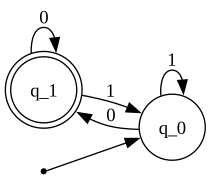
this state machine takes a string as the input, where
$\Sigma := {0, 1}$. it rejects the input 01101, $\epsilon$ (an empty
string), and accepts the input 10110.
the state machine also accepts this input: 1011010101110010, and also
this input: 0. you might have noticed pattern – this automaton
accepts any string that ends in a 0. this is called the language of
the automaton.
language
to formalize the idea above: if $A$ is the set of all strings accepted by $M$, we can say that $A$ is the language of the finite state machine $M$, denoted as the following:
\[L(M) = A\]in plain english, we say that $M$ recognizes $A$.
note: a machine may accept several string, but it always recognizes only one language.
designing state machines
now since we know what a state machine is and what is a language, let’s try designing some state machines that only recognizes one language.
for all of these state machines, we assume that $\Sigma = {0, 1}$.
example 1
problem: design a state machine $M$ where $L(M) = \emptyset$ ($M$ recognizes no languages).
solution: one approach is designing a state machine that will start and end in a reject state regardless of the input.
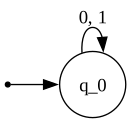
we can make it a bit more complicated:
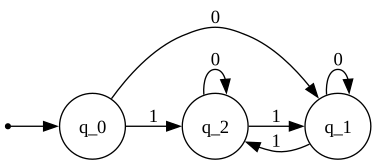
since this dfa also have no accept states, it will always end in a reject state, no matter the input. however, let’s look at this solution:
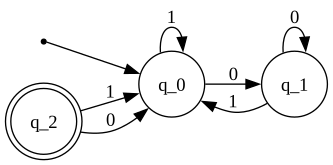
this solution also works, even though there is an accept state. however, it is impossible to reach this state, as there are no arrows (transition functions) that points to the accept state. when there exists a state that have no arrows pointing to it, we call that state an unreachable state.
note that these concepts also work the same for a state machine that always end in an accept state. the machine either just don’t have an accept state, or the accept state is unreachable.
example 2
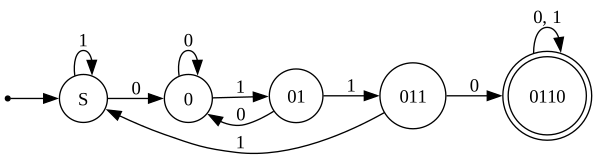
problem: design a state machine $M$ such that its language is the
set of all strings that contain 0110 as a substring.
solution:
example 3
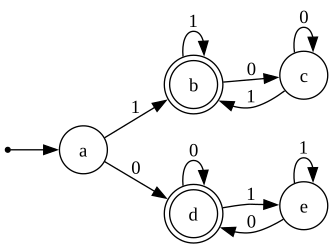
design a state machine $M$ such that its language is the set of all strings that start and end with the same symbol.